Why I Built the Triage Tool
The feeling nobody talks about
I've walked into a lot of projects mid-flight.
You know the feeling. New faces, unfamiliar acronyms, process flows that made sense to someone once, a history you weren't part of. Everyone else is in the thick of it. You're taking notes, nodding, trying to map the landscape fast enough to be useful before anyone notices you're still finding your feet.
Nobody walks into a new project and understands it immediately. Anyone who tells you they do is either lying or about to make an expensive mistake.
The fundamentals haven't changed. The noise has.
Project management hasn't changed much in fifteen years. The fundamentals are the same: understand the goal, know who owns it, get the right people in the room, make sure everyone agrees on what done looks like. What's changed is the noise around it. The buzzwords. The tools. The pace. The expectation that you hit the ground running on day one.
The thing nobody tells you is that the most valuable thing you can do in that first phase isn't to have the answers. It's to ask the right questions. Quietly, privately, before you walk into a room.
That's where I'd find myself: transcript from a kick-off call, a set of meeting notes, a project brief that raised more questions than it answered, trying to pick it apart in whatever time I had. Asking what I'd call the silly questions. The ones you can't ask out loud because everyone assumes you already know. The ones that, once answered, make everything else make sense.
The question that cuts through everything
The ah ha moment. Every project has one. The point where the fog clears and you see what you're actually dealing with. Not the surface problem. The real one. The political one. The one nobody's said out loud yet.
I built the triage tool to get there faster.
It's not a PM tool. It's a thinking tool, for anyone who's in the middle of something that's gone sideways and needs to clear their head before walking into a room. A project leader. A business owner. A consultant brought in late. Anyone whose head hurts because there's too much noise and not enough signal.
The question I learned to ask in the first hour, the one that cuts through everything, is this:
What happens if we stop this project tomorrow?
Not because stopping is the answer. It almost never is. But because the answer tells you everything about what the project is actually for. A new product feature. More revenue. A regulatory deadline. A commitment made to a customer. When a project is in trouble everyone is firefighting the visible symptoms. Nobody is talking about why it matters. This question puts that back in the room.
A note on AI
AI is everywhere right now. Everyone's using it, everyone's talking about it. But the worst thing you can do with a tool like this is take what it gives you straight into an exec meeting. You read it. You challenge it. You change what's wrong. If it spits something out you don't understand, that's your signal to dig deeper, not to nod along.
What the tool actually does
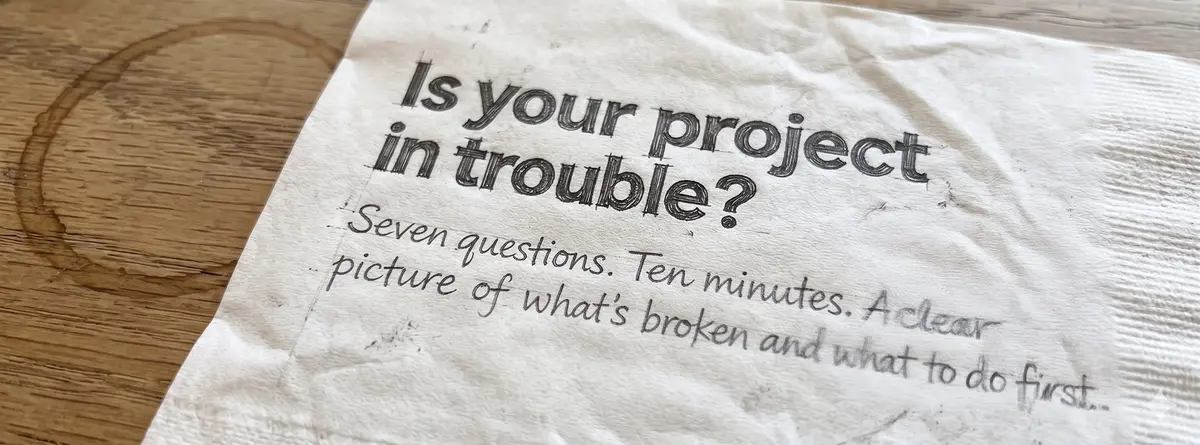
What the tool actually does is give you headspace. A structured conversation that forces the real questions to the surface. Six inputs, one output: a one-page brief you can take into a room, share with a stakeholder, or just use to think more clearly.
A bit like the smart capture feature in ka-do: you give it the raw material, it turns it into something you can act on. The AI does the pattern matching. You do the thinking. That's the right division of labour.
The report it produces isn't the point. The point is the clarity you get from working through the questions. The ah ha moment, faster.
Start here
If your project is in trouble, or if you're just new to one and trying to find your feet, start here.
https://altitudeconsulting.uk/tools/project-triage/
For the reasoning behind the seven questions themselves, see What Is Project Triage? For what comes after the diagnosis, see the full project triage and recovery guide.
Written by Steve Drew — most of his career running delivery inside large organisations, currently building ka-do alone.
Read the recovery guide →Get new posts by email
Occasional, no spam. Unsubscribe anytime.